Thursday, June 25, 2009

Review 24: Death from the Skies!


Death From The Skies! by Phil Plait

I've always found the end of the world fascinating. So many cultures have put together their own ideas of how the world will end, from the Norse Ragnarök to the Christian apocalypse to the Hindu cycle of creation and destruction. We live in a world that was, for a long time, unpredictable to us and on many occasions seemed to be outwardly hostile. Our ancestors faced floods and earthquakes and disease, with no idea of where these things came from, why they happened or how to stop them. And so they made myths and stories to explain the dangerous world in which they lived. From that, they extrapolated - if the world is this dangerous now, how dangerous could it be if it really tried? And so came our myths of a world that not only succeeds in hurting us, but in wiping us out altogether.

Even in the modern age we have our myths. Books, television, and movies all use the end of the world (or end of a world) to tell stories - usually about the resilience of mankind and our ability to pick ourselves up, dust ourselves off, and rebuild human society, hopefully for the better. As good as this is for fiction, there are two problems when we try to apply these myths and stories to the real world: the world will end, one way or another, and no amount of heroics, cleverness or pluck will save us. Not in the long term, anyway.

Science has accomplished what religion and fiction could not - it has seen the future and can make fairly accurate prophecies about how this world, and our civilization upon it, will die. Renowned astronomer Phil Plait is your prophet for this trip into all the ways the world will end....

In this book, Plait looks at nine possibilities for the end of the world as we know it. In order, they are:

Death by Impact
Death from the Sun
Death by Supernova
Death by Gamma Ray Burst
Death by Black Hole
Death by Aliens
Death of the Sun
Death by Galactic Collision
Death of the Universe

In each chapter, Plait outlines the ways in which that specific event could injure or kill us, with as much science as he can comfortably put in. He explains, for example, why we can't just send Bruce Willis up to hit an incoming meteor with a nuke (it probably won't work) and why any black holes produced by the LHC won't do us any harm. He looks at how a supernova happens, what it is about a black hole that turns it into one of the deadliest weapons in the universe, and tries - very, very hard - to make the reader understand exactly how long "forever" is. (Hint: it's a lot longer than you think. Longer than that, even. Nope, keep going....)

Each chapter outlines the processes by which we could experience the destruction of our civilization or, in a few cases, the planet itself. He looks at the scientific foundations of these events, explaining in detail what it is about the sun, for example, that makes it a cauldron of chaos and torment, or why we really, really don't want to get even a smallish black hole anywhere near the planet. And I have to say, of all the unlikely ways we could be toasted, gamma ray bursts are my favorite - a deadly beam of energy from thousands of light-years away, cooking the planet all the way down through the crust and utterly devastating the planet's ecosystem so as to kill off anyone who was lucky enough to be on the other side of the world. I mean, wow. And there'd be no warning, either. By the time we knew what was happening, it'd be too late. So that chapter (with a line paying homage to Douglas Adams, even) is just mind-boggling.

Probably my favorite chapter, though, is the one about supernovas, mainly because his careful, step-by-step description of exactly how a supernova occurs made me think, "What I wouldn't give to see that in person," disregarding the fact that a) the best parts would happen way too fast for me to observe and b) it would vaporize me. Still, it's a beautiful and terrifying chain reaction, which Plait describes in fantastic detail. The other chapter that evoked the same reaction was the one on the end of the universe. Despite timelines for which the word "vast" is terribly inadequate, Plait tells us what science knows about how the universe will end - the ever-increasing expansion of spacetime, the eventual death of the stars, evaporation of galaxies, the reign of the black holes and the slow, careful deaths which even they face. It all ends in darkness, all matter gone into a few stubborn subatomic particles and the eventual collapse of the very fabric of space and time.

And as bleak and miserable is the future looks, I still thought, "I really want to see that." So if I can figure out how to live one googol years (that'd be a one with one hundred zeros after it [1]) and not have my very atoms decay into nothingness, then I'll be able to... um... be really, really bored, probably. Since after that, there's absolutely - literally - nothing to do. Until the universe experiences vacuum collapse, or a brane collision, possibly hitting the reset button on the cosmos and we get to do it all over again....

Most of what's in the book isn't new to me, but that's probably because I grew up reading Cosmos, and I follow countless science TV shows, podcasts and blogs (including Plait's own Bad Astronomy blog, which is well worth keeping up with, as well as his regular appearances on SETI's podcast, Are We Alone? and occasional guest appearances on The Skeptics' Guide to the Universe - both of which make for excellent listening). For people new to astronomy, though, this will be a rather dense learning experience - and reading it will be time well spent.

In addition to its user-friendly style, I really like the way it's arranged - from small-scale (relatively) to large, with "Things that are absolutely certain to happen" at the beginning and end, and with "things that probably won't happen" in the middle. And my favorite aspect of this book is that each chapter begins with a short vignette describing that particular end of the world, from the perspective of someone watching it happen. It's not something you often see in books of this nature, and I'm really glad that Plait decided to put it in there. It makes it a little less academic and abstract and more real.

For all its death and destruction, the book isn't really a downer. For one thing, while things like asteroid impacts and the death of the sun are inevitable, they don't have to be fatal, and Plait describes a few ways in which - in theory - we (or our distant, distant descendants) might be able to avert or at least mitigate these catastrophes. It's not easy, of course, but saving the world never is.

It's mainly a marvel at the forces that surround us in the universe. It's easy to forget, looking up at the sky from our brief, limited scale, that the universe isn't just some pretty lights drifting about in empty blackness. Things are exploding and dying, burning and freezing, moving quickly and slowly - the cosmos is replete with activity and danger. Most of the universe isn't just uninhabitable, it's actively hostile to life as we know it. And yet, without the black holes, the supernovas and the galactic collisions, without massive meteor impacts and breakaway comets, solar flares and deadly radiation - without all that, life probably wouldn't exist at all. So read this book, and take a moment to appreciate how lucky we are to be here at all, all things considered....

-------------------------------------------------
"They say that even the brightest star won't shine forever. But in fact, the brightest star would live the shortest amount of time. Feel free to extract whatever life lesson you want from that."
- Phil Plait, Death from the Skies!
-------------------------------------------------

[1] 10 000 000 000 000 000 000 000 000 000 000 000 000 000 000 000 000 000 000 000 000 000 000 000 000 000 000 000 000 000 000 000 000 000

Phil Plait on Wikipedia
Bad Astronomy blog
Death from the Skies! on Wikipedia
Death from the Skies! on Amazon.com

Thursday, June 18, 2009

Review 23: American Gods


American Gods by Neil Gaiman

I remember waiting a long time for this book. Neil documented the process of writing it on his blog, so every few days I would get a little glimpse at what he was doing - and it drove me nuts. Living in Japan, I can never be sure when my favorite entertainment will make it over here. Movies and books can take months to get from the US to Japan, and while I'm waiting not-so-patiently, all my friends at home have just devoured it and are in the process of raving about how awesome it is. Oh, sure, the hyper-sellers like Harry Potter might have a worldwide release, but Neil wasn't exactly a mainstream superstar when this was written.

So yes, one of my main memories associated with this book is frustration. Fortunately, when I picked up the book during a trip home back in 2001, my frustration was erased and replaced with profound satisfaction.

American Gods was one of Gaiman's first full-length novels, though I may be wrong about that. It was not, of course, his debut - he had made his name a household word in fantasy-reading households by penning the epic comic book series Sandman, in which he proved that he was able to marry huge metaphysical themes to personal narrative. He could make the dissolution of worlds pale beside a broken heart and make you believe that even the simplest of life had vast meaning.

In other words, this man has some serious writing chops.

As the title implies, in this book Gaiman takes on the gods, and asks a very interesting - and important - question: what happened to the gods that came to America? I'm talking about the Old Gods, the gods that had been living in the hearts and minds of people for thousands of years. Leprechauns and dryads, three-in-one forces of fate and representations of the seasons. Easter and Odin, Bast and Anubis, gods of once-great nations and unknown villages. As their people came to America over the millennia, they brought their gods with them.

But as the people stayed in America, they changed. They grew. And the gods discovered that America is not a good place for them.

Now the old gods are small and unworshipped, save by a few tiny, dwindling pockets of their old culture. What's more, new gods are rising, gods of media and internet, highway and television and government. And, as has been said in countless westerns and cowboy movies, there isn't room for all of them. There will be a reckoning, and a man named Shadow is in the middle of it.

Shadow is a convict, nearly at the end of his time in prison. He wants nothing more than to get out of prison and rejoin his wife. He gets one of those wishes when he is released early. Unfortunately, he is released early to attend his wife's funeral.

Without friends or family, Shadow is aimless and alone. It is in this condition that he meets the enigmatic Wednesday, a man who seems to know Shadow and his situation, far better than any stranger should. He offers Shadow a job - to assist Wednesday when he needs it, protect him if he has to, and sit a vigil for him if he dies. With nothing to lose, Shadow accepts the deal. In so doing, he finds himself facing a war of gods that he never knew existed.

It's a great story, on many levels. In one sense, it's a love letter to America. Shadow's journey takes him through small towns that have yet to be subsumed into the ever-devouring maw of the modern American monoculture - from roadside attractions to tiny motels to strange lakeside communities, the unacknowledged weirdness of America is put on display here for all to see. As is its history, in the form of flashbacks to the journeys that people made from their homelands to this land, voluntary or not. The book reminds us that there is a complexity to not only American history, but also to American culture, which gets lost in the ubiquity of McDonald's and Starbucks.

The metaphysical angle of this book is also something to give you pause. It asks the questions about what gods are, how they're born and how they die. Most importantly - how they flourish or wither, and why. It is said over and over again that America is a bad place for gods, although it's not clearly explained why. Perhaps something to do with its geography - a vast, variable landscape that's too big for small tribal gods to get a hold of. Perhaps it's the people, brought from all over the world, who can't help but wonder what other cultures can offer them. Perhaps it's just the nature of its people - always moving, independently-minded. The old gods, who were gods of small nations and regions, simply didn't have the power or flexibility to stay on.

Which really makes us wonder, how did capital-g God manage to get a foothold? As one of the characters notes, Jesus has done really well over here. Perhaps because the God of Abraham can be all things to all people - a god of vengeance and justice, a god of mercy and love, a creator, a destroyer, a personal friend or a distant observer. There is something to be said for non-specialization, I suppose....

This book is a journey, and it's a long and complicated one at that. But it's enjoyable and personal. Gaiman writes with great empathy, so that the reader may even understand the gods themselves, as reduced and attenuated as they may have become. Though Shadow is not exactly the protagonist of the story - he spends most of the book doing what he is told to do, only taking initiative on his own towards the end, he is observant. Through his eyes, we learn more about America. Its triumphs, its flaws and its potential all become a little bit clearer, and upon finishing the book, those of us from that strange, turbulent land can perhaps appreciate it a bit more.

----------------------------------------------
"This is the only country in the world that worries about what it is."
- Wednesday, American Gods
----------------------------------------------

Neil Gaiman on Wikipedia
Neil Gaiman's homepage
American Gods on Wikipedia
American Gods on Amazon.com
Neil Gaiman on Twitter

Thursday, June 11, 2009

Review 22: House of Stairs


House of Stairs by William Sleator

Young adult fiction must be a really tough genre to wrap your head around, for a writer. You have a story that you want to tell, and you have to tell it in such a way that it is simple enough for your target audience to read, yet engaging enough to keep them reading. The themes have to be familiar enough for them to understand and relate to, yet unusual enough to be interesting for them. Go too far in the wrong direction and you have a failure. So how does a YA writer do it, balancing all those issues, while still writing a good book?

Damned if I know. I've never managed to write a decent book for adults, much less young ones.

Fortunately, there are plenty of talented writers who can write for young people, and one of those is William Sleator.

A YA writer who specializes in science fiction, Sleator has written his fair share of strange, fantastic and sometimes disturbing books. Of all the ones I've read, this book is probably the one that creeped me out the most.

The setup for this story is simple. Five sixteen year-old orphans - two boys, three girls - are put into a giant room, with no visible walls, ceiling or floor. The only structures in this room are stairs and landings. Nothing else except for a small machine with flashing lights and odd sounds that dispenses food.

That's it.

The five characters are very different and very interesting. First we have Peter, a scared boy, uncertain of his surroundings in the best of times, and utterly overwhelmed by being dropped into this bizarre place. He's afraid of everything and everybody, and finds solace only his the strange trances he drops into, in which he is with an old orphanage roommate, Jasper, feeling safe and protected. As an interesting aside, it wasn't until I was much older that I figured out Peter's sexuality. It wasn't that thinly veiled, either. I really don't handle subtlety well, I think....

Lola is not a showgirl. Sorry, had to put that in. Lola is a tough, street-smart girl who has no tolerance for stupidity or cruelty. She's had to learn a lot in her time, and doesn't look to others to decide what she should or should not do.

Blossom is a fat little girl who is the first to figure out how to use the food dispenser (in a rage at it, she sticks out her tongue, and out pops a food pellet - but more on this later). She is cunning and devious, much sharper than people would give her credit for being. If anyone is truly dangerous in this crowd, it is her.

Abagail is a mousy girl, pretty in her own way, but with very little in the way of self-confidence. She tends to latch on to other people and question her own thoughts and actions. She does have compassion, however, though not the means to make her compassion a reality.

Finally, Oliver is the other boy of the group, and he is all that Peter is not. He is strong and confident and good-looking. For a while, Peter thinks that Oliver is his old friend, Jasper, and subsequently Peter is devoted to Oliver. A certain power structure evolves when it is discovered that of all the people, only Oliver can bring Peter out of his trances. Oliver has power, and he is not afraid to use it.

These five kids are trapped in this house of stairs. None of them know why they're there, they only know that they are. They soon discover that the food-dispensing machine will only give them food under certain conditions. In the beginning , they are forced to repeat a series of actions and movements, that evolve into a kind of dance, hoping to get food from the machine.

From there it gets only worse. They soon discover that the dance isn't enough. The infighting that comes naturally becomes essential to their survival, for only when they are cruel or greedy will the machine start flashing its lights and entice them to dance. The question then becomes whether or not the kids will do as the machine wishes, and how long they can hold out against it. Or if they will.

This book is disturbing to say the least. It levels some pretty harsh accusations about human nature, not just regarding the kids in the house of stairs, but also regarding the people who put them there. The kids are there for a reason, and not a good one. The whole setup (which is thoroughly, if somewhat clunkily, explained at the end) is about conditioning, and changing people's personality through stimuli and reinforcement to make them behave as desired. Because it demonstrates people, young people in particular, behaving in a manner that displays the truth of their nature, this book has often been compared to Lord of the Flies, and rightly so.

In its way, it's even more disturbing than Lord of the Flies - at least the kids in that book had been left to their own devices, as terrible as they were. In this book, the horrors that these five teens go through are part of a deliberate state-sanctioned experiment in human conditioning - a kind of horrible, Pavlovian Breakfast Club. Such is the nature of that experiment that the two children who resisted the conditioning were actually regarded as failures. Upon reflection, the people pulling the strings are far more frightening and disturbing than these poor, manipulated children.

If nothing else, the lesson to be learned from this story is simple - be a human being. There are some things that are too important to sacrifice for something as simple and petty as food and acceptance. We must never allow ourselves to be beasts. We have to be human. This has relevance today, when we are debating the ethics of torture - is it a necessary evil that we must tolerate if our society is to survive, or is it an offense against our humanity? If we allow ourselves to be fooled into thinking that an evil act is somehow the right thing to do, then we have lost a very important part of ourselves.

Of course, it's also about science, but the message here is less dire - we must not allow science to lose its humanity. In this book, a strange future with a monolithic state government, science is entirely utilitarian, with no moral qualms about putting minors through psychological torture. The good news is that, at least as of this writing, science errs on the side of ethics. Modern science certainly has its moral gray areas, but the majority of scientists out there would never consent to run an experiment such as this. I hope.

The last line in the book is one of the more frightening ones in literature, right up there with the last line in 1984. It's a blunt reminder of everything that has happened in the book, and a pointed summation of everything that Sleator has been trying to say - that humans have a base nature, that we can be manipulated, and we will, given the right circumstances, allow others to shape who we are. His message to his readers - teenagers like the ones in this book - is to refuse to submit to such control. Good advice for them, and for us.

----------------------------------------
"You... you're not going to... to go along with it, are you?"
- Peter, House of Stairs
----------------------------------------

William Sleator at Wikipedia
House of Stairs at Wikipedia
House of Stairs at Amazon.com
Operant conditioning at Wikipedia

Thursday, June 4, 2009

Review 21: The Thief of Always


The Thief of Always by Clive Barker

This book has one of the best opening lines I have ever read:

"The great, gray beast February had eaten Harvey Swick alive."
Having grown up in New England, where February is the punishment that God metes out for all sinners, I have decided that you can't beat that.

Harvey Swick is ten years old, and like so many ten year-old boys, he is bored with his life. The interminable grayness of February, the drudgery of life - going to school, coming home, going to school again - and believes that, if his life became the tiniest bit more boring, he would most certainly perish.

Then he met a strange, smiling man named Rictus, who told Harvey of a wonderful place where boredom could not enter, and there was nothing to be had but fun and adventure. There is no better place for children, Rictus said, than Mister Hood's Holiday House.

Thinking about it, given that Harvey was willing to follow a strange man to a mysterious house without much consideration for his safety, suggests either that Harvey is not very bright, or Rictus is extremely persuasive. Given the rest of the book, I'd bet on the latter.

The Holiday House is truly a place of miracles. The food is better than you've ever eaten and there are enough toys and games and costumes and masks to keep any child happy for the rest of their lives. And in every day there are four seasons - a perfect green spring in the morning, a blazing wonderful summer in the afternoon, an evening full of woodsmoke, pumpkins and fallen leaves, and every night is a white Christmas with a present for each boy and girl.

It is the best place Harvey has ever been, and it takes him about a month to realize that something is not... quite right. Why would the mysterious Mister Hood do this for children? And what happened to the children who had come before? And what's the deal with that cold, deep pond full of big, creepy fish?

It's a coming-of-age book, the kind that chronicles the transition from childhood to young adulthood. Ten isn't exactly young adult territory, but it is a time when kids start maturing in the way they think about themselves and the world. Not for nothing that so many young adult novels feature a protagonist that is somewhere between ten and twelve years old - they're still young enough to have an air of innocence (which inevitably gets torn away) but old enough to think for themselves when there are no adults around to think for them.

There is no end to this kind of book - Neil Gaiman's Coraline, Stephen King and Richard Bachman's The Talisman, John Gilstrap's Nathan's Run, and just about anything written by William Sleator are among my favorites in this genre. They represent a growing-up that we feel we ought to have had, but are happy to have missed. They deal with the concepts that kids have to deal with as they age, and do so in a manner that young people can understand - analogy.

The Thief of Always is a book about getting what you want. Anyone who's spent time around children knows that they're greedy little beggars. They are dominated by their id and don't understand that there are concerns out there that might supersede their own. Harvey Swick is just such a boy. He is concerned with his own excitement, his own happiness, and, having a child's limited view of time, believes that the boredom he feels in the grip of February is permanent. He wants adventure. He wants change and variety, a life that never slows down and never gets old.

As the old saying suggests, however, one must be careful what one wishes for.

In the end, Harvey learns a Valuable Lesson (tm) - to let the future happen in its own time, and appreciate what you have now. Because once time is gone, you can never - or at least very, very rarely - get it back again.

It's a very quick read, but a very good book. I pull it out every February, if only for that opening line. For those who think of Clive Barker as being a master of the gory, pin-headed horror genre, this book may come as a pleasant surprise for you. And if you have kids around Harvey's age, leave this one lying around for them to find. I'm sure they'll appreciate it....

-------------------------------------
"I only took the days you didn't want," Hood protested. "The rainy days. The gray days. The days you wished away. Where's the crime in that?"
"I didn't know what I was losing," Harvey protested.
"Ah," said Hood softly, "but isn't that always the way of it?"
- from The Thief of Always
-------------------------------------

Clive Barker at Wikipedia
The Thief of Always at Wikipedia
"The Beautiful Moment" - a Clive Barker website for all ages
The Thief of Always at Amazon.com

Thursday, May 28, 2009

Review 20: The Doomsday Book


The Doomsday Book by Connie Willis

I honestly can't count the number of times I've read this book. I think this is the fifth time. Or maybe the sixth, I don't know. It doesn't really matter, because it's just as enjoyable, touching and heartbreaking as it was the first time I read it, and that's a hell of an accomplishment.

It is the middle of the 21st century and time travel has finally been worked out. A reliable there-and-back-again way to go into the past and come back to the present. Unfortunately, there are limitations. The computer that makes time travel happen, through means I'm not sure even Ms. Willis understands, will not allow for a paradox. This means if you try to go to the past with anachronistic technology, or carrying a disease that could wreak havoc on the population, the interface simply won't open. If you try to place a traveler somewhere where their appearance could cause a paradox, the machine will put them in another place or time - a factor called "slippage" which can put you anywhere from five minutes and a few feet off your mark to years and miles. The machine won't allow you to get anywhere near events of importance.

Secondly, the machine won't allow you to take anything through the net. So if you travel to, say, Napoleon's palace and try to rob him blind, the interface won't open until you've got rid of all your booty.

Those two factors alone made the time machine economically useless. If you can't profit off it - or change it - what good must it be?

A lot of good, as it turns out, if you're an historian. While the machine may not allow you to get anywhere near Hitler, it will allow you to see what life was like in the ghetto in the 30s. The whole of history suddenly became open to real discovery, and places like Oxford were at the forefront of the research.

One student, a young lady named Kivrin, has a dream to see the Middle Ages. Despite all the warnings that it was full of filth, disease, superstition, danger and death, she still wants to see it more than anything in the world. The sheer force of her will finds her in the machine, ready to go to the year 1320 to see firsthand what life was like for the average English citizen. She has prepared herself as best she could, but nothing could possibly prepare her for the time and place she ends up in....

And in the present, a new plague has spread around Oxford. It's a new type of flu that seems to have come from nowhere, and it's started to kill. Kivrin's teachers and friends have to race the disease, time and sheer bloody-minded bureaucracy to try and find her and bring her back safely.

What is remarkable about the book is the detail. Willis has obviously done a lot of research into not only Medieval Oxford but modern Oxford as well. Since one of the themes of the book is that we don't know nearly as much about the past as we think we do, Willis has gone to great lengths to make sure that we - through the eyes of Kivrin - never know what to expect because our expectations are all totally wrong. And as is so often true about history, the more we know about it, the more interesting it becomes.

The Oxford of the future, by contrast, isn't all that futuristic. It looks a lot like the modern world, probably because it's only a couple of decades removed from us. Sure, there have been advances in technology, but the lives of the people aren't much different from ours.

Interesting note: the book was published in 1992, well before the age of cell phones, instant messaging and the internet. Because of this, one of the greatest hindrances to getting anything done in this far-future Oxford is that no one can get anyone on the phone. It's a videophone, yes, but most of the characters spend time waiting for phone calls to come through or trying to place calls to people who aren't near a terminal. It's a bit strange, from my modern perspective, to see a world that has pretty much conquered disease and mastered time yet never figured out a means of personal communication better than a land-line.

That's just a small thing, though, and as long as you accept that particular bit of alternate-future, you'll be okay. It's a fantastic book, one which I recommend without reservation. The characters are deep and interesting, and the writing really puts you in their world. Seriously. Go get it.

----------------------------------------------
"Mr. Dunworthy, ad adjuvandum me festina."
("Mr. Dunworthy, make haste to help me.")
- Kivrin, The Doomsday Book
----------------------------------------------

The Doomsday Book on Wikipedia
Connie Willis on Wikipedia
The Doomsday Book on Amazon.com
The 11th-Century Domesday Book at Wikipedia
The Domesday Book online

Thursday, May 21, 2009

Review 19: Day of the Triffids


The Day of the Triffids by John Wyndham

I have a long fondness for Apocalyptic novels. The Stand was one of my early favorites from junior high school, and I really enjoyed its cousin by Robert McCammon, Swan Song. There's something about the End Of The World that just grabs me and won't let go. Maybe it's the thought that, should the world end, I would be one of the survivors. The rule of law would break down, all shackles of modern life would be loosed, and I would finally be free to choose my own destiny. Which, knowing me, would probably be very short and end up with me getting shot by some kind of Mad Max pirate tribe.

I can say with some certainty, however, that in this book's scenario I would not be coming out on top. Because I love astronomy.

Let me explain. This end of the world came in two parts, at least one of which was definitely of our own doing.

It started with a comet. Or a meteor shower. Or something, but whatever it was, it lit up the sky. Green streaks of light brightened the night skies around the world, and everyone who could go and watch them did so. I'm a sucker for a natural light show, so I probably would have spent the night watching the skies and enjoying myself. And I would have woken up stone blind the next day.

That in itself - the vast, vast majority of the human population on Earth being blind - would have been a pretty good apocalypse. Wyndham describes rashes of suicides, accidental deaths and, of course, murder in just the first few days. Without vision, the carefully crafted world we've made kind of falls apart. But it would have been survivable. Co-operation groups spring up pretty quickly, both voluntary and otherwise, where sighted people assist the blind in surviving. It would have been tough, yes, but not impossible, for the world to go on. If not for the Triffids.

While we don't know what caused the green comet, the Triffids were definitely our fault. The product of bioengineering gone haywire, the Triffids are ambulatory carnivorous plants with a poison sting that can kill a grown man from ten feet away. And while they're not intelligent, they are remarkably... aware. They follow sound, they learn and co-operate in hunting, and are very difficult to eradicate.

But by themselves, they're manageable. Their stingers can be removed, even though they grow back eventually, and they make interesting garden plants. And they're immensely profitable - the oil derived from a Triffid outdoes every other kind of vegetable oil available. In normal times, the Triffids are under human control and benefit humanity greatly.

The two problems, when put together, make for a truly terrifying end - an unstoppable, unthinking army of carnivorous plants, finally freed from their shackles. A world in chaos, half-blind and not sure if they have to save themselves, or if someone else will do it for them. And an exciting story.

The message of this book is pretty clear, and Wyndham wastes no time in making sure we get it, lest the adventure part of the book get bogged down. Don't mess with nature. That's pretty much it. Don't mess with nature, because nature will inevitably come 'round and mess right back with you.

Wyndham has created a brave new world for us, with a wide variety of characters who all react to their new situation in different - and realistic - ways. Starting in London, we meet a diverse cast - from the girl who believes that the Americans will save her to the man who believes that polygamy is the way to a brighter future, everyone has an idea on how to survive. The narrator, Bill Masen, knows just enough to get the reader up to speed, but not nearly enough to know if he's even going to make it out of this alive. With the help of other sighted survivors, he is determined to make a stand, not only for England, but for the human race as a whole.

But first they have to deal with the Triffids....

----------------------------------
"When a day that you happen to know is Wednesday starts off sounding like Sunday, there is something seriously wrong somewhere. "
- John Wyndham, Day of the Triffids
----------------------------------

Day of the Triffids at Wikipedia
John Wyndham at Wikipedia
Day of the Triffids at Amazon.com

Thursday, May 14, 2009

Review 18: Swan Song


Swan Song by Robert McCammon

Okay, have you read The Stand? Humanity being wiped out by a short-sighted government, small groups of people struggling to survive in an America laid low? A dramatic escape from New York through a dark and scary tunnel? An evil adversary from an unknown place whose only dream is the end of the world?

Yeah, that's Swan Song, too. Only with nukes instead of a virus.

It really is an alarmingly similar story, published about ten years after The Stand, but - and this is important - it's still a really good book. Derivative? Sure. But it's still good, which is a neat trick.

The story starts in an alternate world, one that seemed all-too-probable in 1987, when this book was published. The US and the Soviet Union are toe-to-toe, fighting proxy wars all over the world. Nuclear exchanges have already happened between smaller nations. The world is inches away from war, and there seems to be no going back.

Domestically, things aren't much better. In New York City, the city has fallen to crime and decay - drugs, trash and whores are all that can be found, and if any city deserves destruction it's this one. It's the worst projections of New York come true, and its eventual destruction is almost like a blessing.

In the western mountains, a group of survivalists have hollowed out a shelter against the possibility of The End, and Earth House is full to bursting. Young Ronald Croninger and his parents are there, but the boy is not impressed by what he sees. Colonel Macklin,the ex-soldier who is the public face of Earth House, seems to have gone to seed, and the shelter itself is falling apart, just like everything else.

The world is going straight to Hell, and it's all too easy for the US and the Soviets to send it all the way there.

The book has an epic scope and a massive cast, lined up pretty equally on the sides of Good and Evil. As the book progresses, the disparate groups finally come together in a final confrontation that will decide the fate of the world.

In the midst of all that, a certain mystical quality has arisen. There's a... being, a creature of demonic countenance who can change his face and travel freely throughout the wasted land. His sole desire is to see the end of humanity - he revels in destruction and despair and wants nothing more than to see the end of Our Heroes. On the other hand is the title character, Swan. As a girl, she loved plants and flowers, and had a strange affinity for the natural world. As she grew up, however, her powers matured, and that affinity became a full-on partnership. They each collect a following, through fear and hope respectively, and they each know that there's only one way this can all end.

There's an element of mysticism to this as well, though why it should be there is not explained. For example, the burned-out rubble of Tiffany's on Fifth Avenue creates a shining glass ring, filled with strands of precious metals and valuable stones. This ring becomes the guide for Sister, a woman who was once mad but becomes the sanest one of the survivors. With the ring, she is able to perform miracles. There's a magic mirror that shows the future, prophetic dreams and other elements of mysticism. It seems that when the world as we know it ends, the world as we don't know it steps in. And then there's the Job's Masks - a mysterious growth that covers a person's head in an impenetrable shell, only to crack open years later and.... Well, I'll let you find out.

The appeal of apocalyptic fiction is an interesting one, and easily understandable. Humans have been interested in how the world will end since about the same time we figured out that the world could end. And there are many ways for it to go, whether it's the nuclear fire of this book, the insidious virus of The Stand, the near-miss religious apocalypse of Good Omens, the various meteor impacts and climatological disasters that Hollywood loves to show us.... The ways in which the world ends are countless, but they all share one distinct feature - when the end comes, you'll find out who you really are.

It's tempting, then, to give it some thought and wonder, "Who would I be, when all was gone?"

This book has some excellent role models to choose from - and to avoid. The characters are compelling, and the world is vividly drawn, so as long as you're not thinking, "But this is just like The Stand!" you should greatly enjoy it. I highly recommend it.

-------------------------------------------------
"Once upon a time, we had a love affair with fire."
- Robert McCammon, Swan Song
-------------------------------------------------

Swan Song at Wikipedia
Robert McCammon at Wikipedia
Swan Song at Amazon.com
Robert McCammon on Swan Song
Robert McCammon's homepage

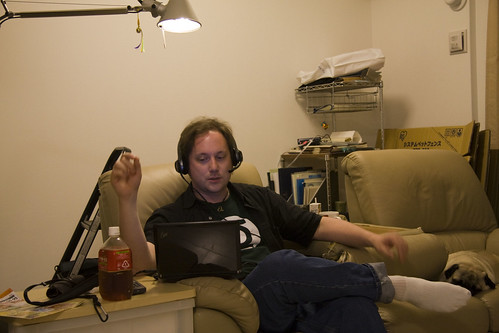
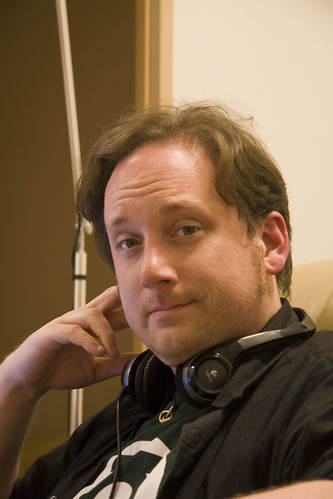
BONUS! The Boyfriend decided that there needs to be pictures of me recording the podcast. So he took some....

Doing the Podcast

Doing the Podcast
Listening to the playback. I've had a haircut since then....